


When we look at the world of technology, we see what is already there. Android and iPhone dominate, so we regulate app stores. Meta dominates, so we regulate ad targeting. We notice how dependent we are on American technology, so we tell ourselves to switch from WhatsApp to a European messanger, from US clouds to EU clouds.
What we are doing is this: We take a photo of a thunderstorm at the moment lightning strikes. We mark the exact spot it hit. Then we build a hut there, with a lightning rod on top, precisely where the last flash landed.
But the lightning can hit everywhere, all the time
The hut will work, for that one spot. Next time a storm passes through, that exact patch of ground will be safe. But will the next flash hit there again? Where will we actually be standing when the next storm comes through? Do we build a hut at every place we might ever stand? And are storms becoming more frequent, not less? Is that even something we should be trying to prevent, or is it just the new climate we now live in?
The point this metaphor indicates at is: we miss the better solution when we stay fixated on the one problem everyone can see and point to: Europe's one sided dependence on American technology.
The storm did come from somewhere
Here is what I propose instead. Look at what happened before the thunderstorm, not just where it struck. Understand how weather forms, how it shifts over time, and what you can actually do once you understand the climate you're now living in.
To be clear from the very beginning: The problem of European dependence on US tech is real. The flash lands regularly. In the form of a kill switch, it could land almost anywhere in our tech landscape. It landed once already, when the US government ordered Anthropic to suspend access to two of its newest AI models over export control concerns, for eighteen days, before lifting the order. Nobody was seriously hurt, because the flash happened to hit a place where nobody was standing yet. But the same kind of flash could hit the hyperscalers just as easily. Or VMware. Android. iOS. Windows. Citrix. NetApp. Printers. CPUs. GPUs. Any part of the American technology we now build our organizations on top of.
Applied to technology, that means asking three things. Why American technology is so dominant today? What are the patterns of setting positions of dominance? And what can we learn to shape future positions of power to our liking?
Technology moves in Cycles
To understand the patterns, we can time travel to the year 2000. Then, we fought against a Windows monopoly. At the time Microsoft's operating system held close to ninety percent of the market, and if Microsoft decided you shouldn't run something on it, you simply couldn't. We did the same thing then that we're doing now. We looked at where the flash had hit and built a hut. The EU opened its antitrust case, forced Microsoft to unbundle Windows Media Player, and fined the company hundreds of millions of euros. At exactly that spot, the flash would never hit again.
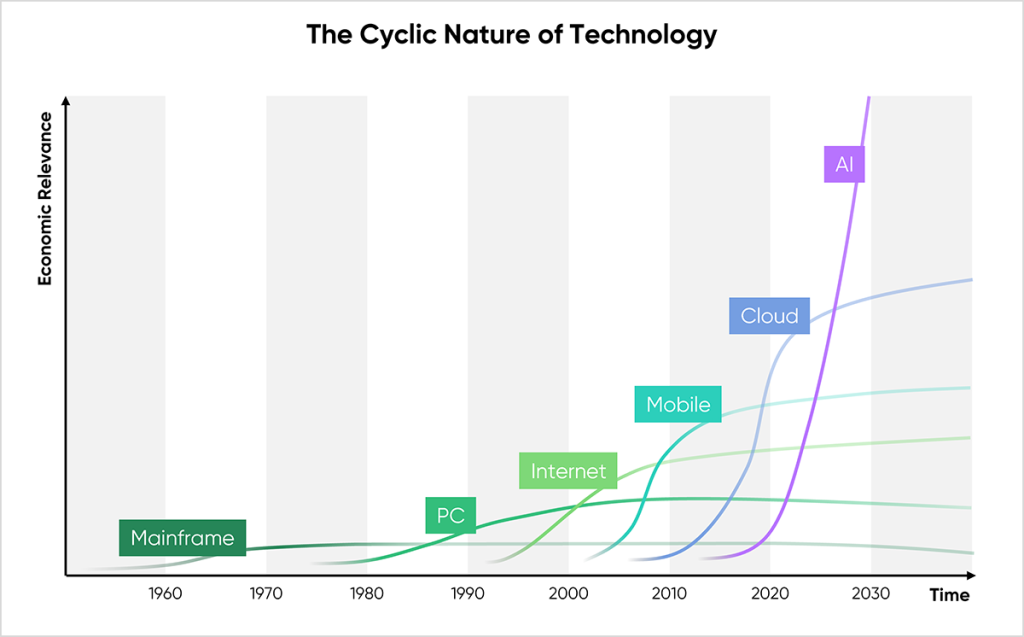
But what happened next? Microsoft didn't lose the desktop. It still runs most of the world's PCs today. But Microsoft lost its position of dominance because the fight moved somewhere else entirely. Two mobile ecosystems, Android and iOS, took over global computing power from a direction nobody had regulated, because nobody had been standing there yet. By 2011 smartphone shipments had already overtaken PC shipments worldwide, and Android alone accounted for roughly half of all smartphones shipped that year. In the years around and after that shift, an entire wave of new businesses with new dominant positions arrived that the old fight never touched: online shopping, cloud computing, social media.
The pattern of gaining dominance in technology
Zoom out and the same pattern repeats across the history of technology, wave after wave.
Start with a dominant platform. Mainframes, for example. Built for a narrow set of high value customers, banks, airlines, governments. Reliable, but clunky and expensive. The marginal cost of building one more mainframe, of running one more workload on a mainframe is high, both in hardware and in the specialized labor needed to operate it.
Then a new technology arrives. The personal computer. Suddenly computing gets radically cheaper, easier, faster to deploy. This is the mechanism the economist Jeremy Rifkin later described as the zero marginal cost effect: once the fixed cost of a digital technology is paid, the cost of using it one more time collapses toward zero, and whoever owns that fixed cost first gains a structural edge over everyone still paying the old marginal cost.
Falling marginal cost doesn't just make the old task cheaper, it increases demand for the underlying technology. A relationship economists have understood since Alfred Marshall's work on price elasticity over a century ago. But there's a second, stranger effect layered on top. When marginal cost falls far enough, people don't just buy more of the same thing. They invent entirely new uses for it that made no economic sense at the old price. This is the Jevons paradox: efficiency gains don't shrink total resource use, they expand it, because they open the door to applications nobody had reason to consider before.
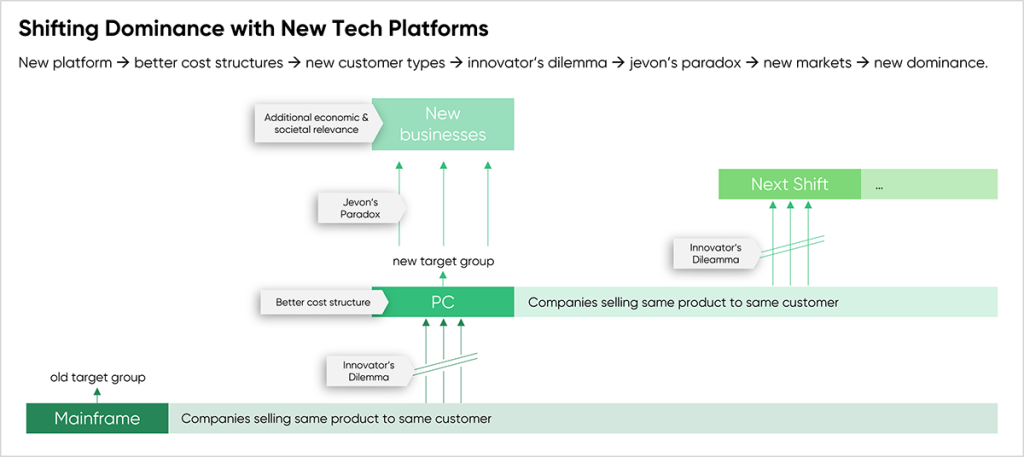
This is exactly where the incumbent gets stuck, and Clayton Christensen mapped why. The old vendor serves its existing customers extremely well. Those customers want more of what they already have, not the new thing. The new demand created by falling marginal cost looks small, low margin, and strategically irrelevant to the incumbent, right up until it isn't. IBM's mainframe business was built and staffed to serve large institutional clients. Personal computing, sold to individuals and small offices, didn't fit that model commercially, and by the time it clearly mattered, someone else already owned the new platform. Microsoft became that new platform. Until Apple and Google disempowered it again with mobile.
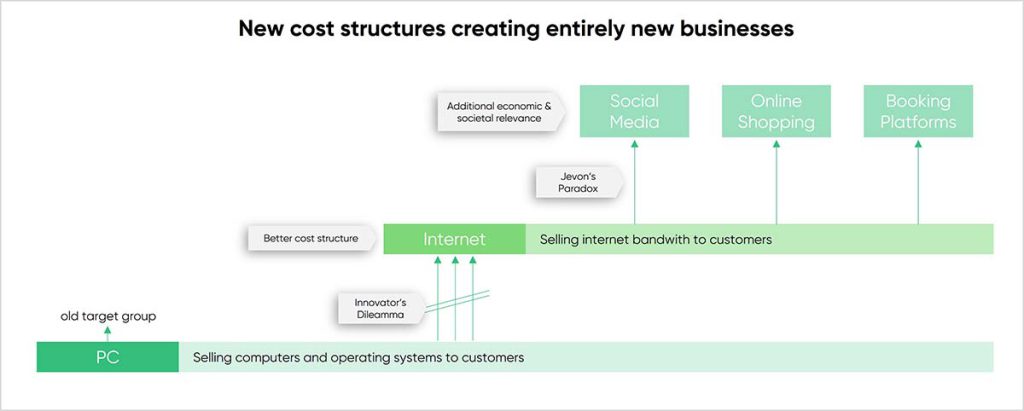
One sidenote: all of these platforms still exist, all of the business models behind it, too, but the power shifts to new actors.
And another sidenote: The biggest business to come out of a platform shift is rarely the company that built the underlying technology. Look at the internet wave itself. The infrastructure was built by telecom carriers. The fortunes were built on top of it, in online shopping, social media, cloud computing. It's the old story of the gold rush: the people who got rich aren't always the ones who found the gold. Often it was the ones who sold the shovels, or who built the hotel next to the mine.
The AI reconfiguration window
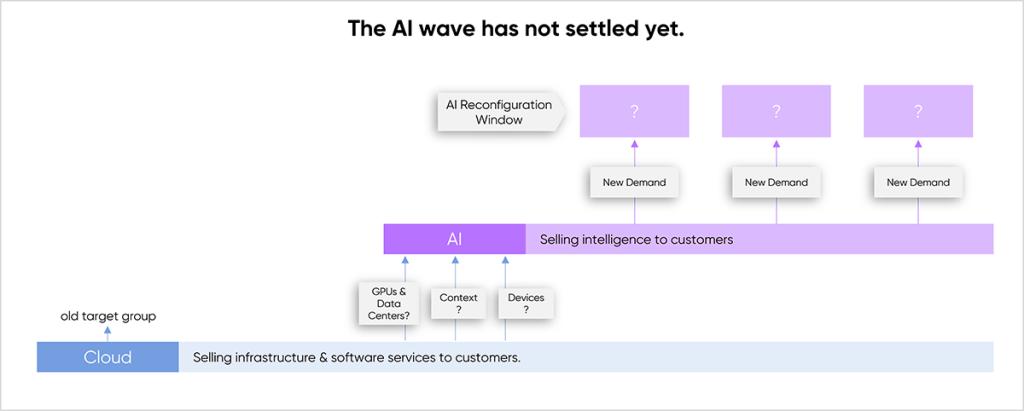
Every platform shift follows the same physics we just walked through. AI is that cycle now. The marginal cost of intelligence is falling toward zero. What nobody has settled yet is where the next dominant position forms once the dust clears.
Four scenarios are competing for that answer right now:
- Scale incumbency says nothing changes. Whoever owns the GPUs, the data centers, and the frontier models today keeps the advantage. This is the flash we are all staring at, the giants who already dominate. But the numbers do not hold up cleanly. Analysts estimate the industry needs something like 600 billion dollars in new revenue just to justify what has already been spent. Straight lines rarely survive contact with a platform shift.
- Context control says the models themselves become commodity, cheap and interchangeable like electricity, and the real value moves to whoever owns the proprietary context around them: the workflows, the domain data, the governance logic that tells a generic model what to actually do inside a real company. This is a layer nobody currently owns outright. The winner here is whoever becomes the default orchestration layer sitting between the model and the enterprise, not whoever trained the model. Palantir, ServiceNow, and Salesforce are already racing to own that layer with AIP, AI agent platforms, and Agentforce, while European players like SAP and Celonis are pushing the same bet from the process and workflow side.
- Embedded intelligence says AI shifts from data centers to the edge. Push the model into the chip, into the device, and you no longer need the hyperscaler at all. A Canadian startup already showed a language model running directly on silicon, no cloud in the loop. If this scenario wins, the chokepoint moves to whoever designs and manufactures the hardware. The winner is whoever controls the compiler that turns any model into silicon, since that becomes the new gateway every model has to pass through. Toronto based Taalas is the clearest early mover, having hardwired Meta's Llama 3.1 model directly into a chip and demonstrated inference speeds far beyond GPU based systems. But the true winner in this case may turn out to be Apple and Google as they control the distribution mechanisms of the edge devices the LLMs are embedded on.
- Paradigm reset says the transformer itself gets replaced. If that happens, today's LLM players may strand overnight, and the winner is whoever moves first on the new architecture, not whoever spent the most on the old one. The winner is whichever lab gets a genuinely new architecture into production first, since the head start compounds the same way the transformer's did. State space models are the leading challenger right now, with AI21 Labs' Jamba and IBM's Granite already shipping hybrid Mamba transformer models in production.
Here is the point of naming all four: nobody knows which one wins, or whether it ends up being some mix of all four at once. And that uncertainty is exactly where the two continents part ways.
Europe stands at its watchtower, staring at the storm, waiting for the flash to land to know where to build the next hut. That's regulation as a posture: reactive, precise, and always several steps behind the flash.
America runs a different metaphor, one closer to its own founding myth. It's a gold rush. Nobody knows exactly where the gold sits in the mountain. So they go in anyway, dig where the signs look promising, waste money on empty claims, and let the market sort out who struck the vein. It's dirty, wasteful, and expensive. It's also how you actually find gold before someone else does. And even if you don’t find much gold, you make money selling shovels.
Europe’s Window of Opportunity
Both metaphors earn their keep, because they point to the same mistake from two directions.
We keep building rainsheds where the last flash hit: regulate the App Store, regulate the ad monopoly, mandate an EU cloud. All reasonable, all aimed at yesterday's weather. None of it touches where the next flash lands, because the next flash hasn't decided where to land yet.
Europe's real opening is not in outbuilding NVIDIA or training a bigger frontier model than OpenAI. That claim is already staked, and the fight for it is already lost on capital alone. The gold worth digging for sits somewhere else: in the layers that AI is currently redrawing inside sectors Europe already has depth in, manufacturing, industrial machinery, pharmaceuticals, insurance, public administration. These are exactly the regulated, process heavy, physically embedded sectors that never show up in a Silicon Valley pitch deck, and exactly the sectors where context control and embedded intelligence will matter more than raw model scale. Nobody has staked this claim yet, because nobody serious has started digging here.
Where to dig?
Our vein runs on a different model: the unfair advantage. Europe already holds one, in specific industries, built over decades. Machinery running for twenty years leaves behind decades of sensor data nobody else has access to. Insurance actuaries hold loss histories going back generations. Pharmaceutical manufacturers hold process data that took a lifetime of regulatory compliance to accumulate. This isn't a claim Europe needs to stake. It's already ours.
What AI and cloud do is let us finally scale that advantage. But scaling it means giving something up. It means we stop selling the machine and start selling what the machine knows. Amazon didn't just build a bookstore, it turned its own logistics data into a product, and then opened its own infrastructure to the rest of the world, competitors included, and built a bigger business doing that than it ever built selling books. That's the model. Take the unfair advantage sitting inside your own value chain, and build the next platform on top of it, even if that means changing what you sell.
This is where Europe's own instinct works against it. We keep treating this shift as a lightning strike, something happening to our industrial base that we need to defend against. It isn't. It's a vein running straight through the ground we're already standing on. The only way we lose it is if we make IBM's mistake ourselves, protecting the business of selling machines so hard that we never build the business of selling what those machines know. The innovator's dilemma isn't just something to exploit in someone else's blind spot. It's something to avoid falling into in our own.
That's the vein. Not a bigger frontier model, not a faster GPU. Decades of value chain data sitting inside European industry that nobody else can replicate. We already had the right instinct once, Gaia-X and the European data spaces were early attempts at exactly this. They failed, not because the idea was wrong, but because of how we tried to build it. More on that in the next piece. For now: the instinct of Gaia-X was correct, and the window to build on it properly is still open.