
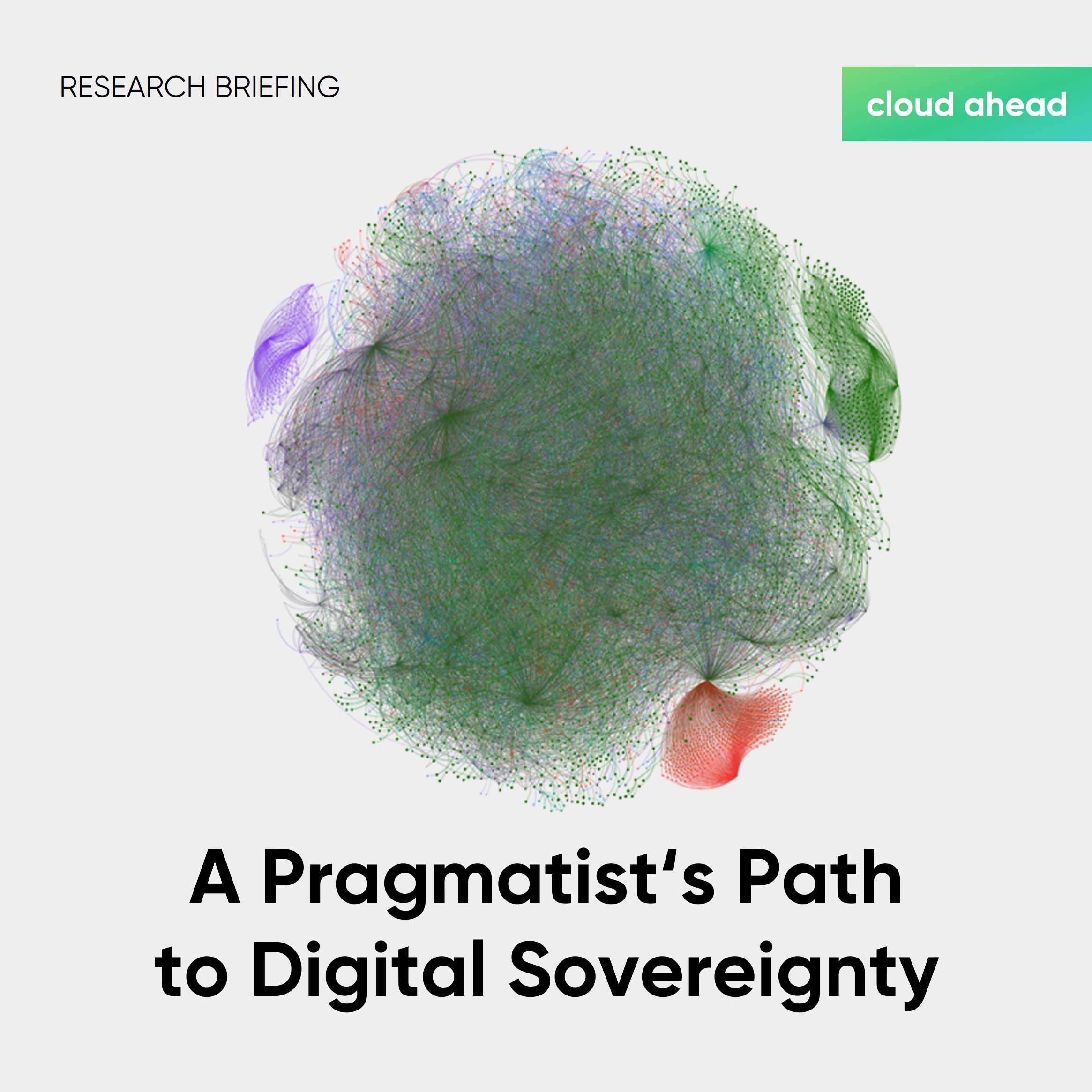
Download the research briefing here.
Europe will not become sovereign by removing technological dependencies. There are simply too many of them, and they keep evolving structurally. While open source and European cloud offerings reduce dependencies at the mature end of the stack, consumers, SMEs and corporations are simultaneously creating new ones at the emerging end, most visibly in AI.
This paper argues that our reliance on foreign technology is too structural and too deeply anchored in how Europe invests in and consumes technology to be eliminated outright. Instead of trying to escape dependencies, Europe should focus on managing the risks and leverage they create more effectively.
The global tech stack is a coin with two sides
Modern technology is built on a deeply interconnected global stack. Applications depend on thousands of software components, infrastructure tools, cloud services, hardware, manufacturing equipment, raw materials and energy. Every new technology generation adds another layer rather than replacing the old one.
This complexity creates dependencies, but it also creates enormous value. AI is a good example: organizations can access the world’s most capable models almost instantly and at very low marginal cost because others have invested billions in infrastructure and deployment. Yet, as adoption grows, so do dependencies and the risks they create. The very mechanisms that make the global tech stack so attractive are therefore also what make it risky.
Sovereignty is an economic question
Every sovereignty decision trades off risk, cost and capability. More control may reduce risks, but usually requires more investment, higher operating costs or lower access to scale and frontier technology.
European engineers could replace far more foreign technology than they do today. Ukraine’s rapid build-up of domestic drone production shows how quickly capabilities can emerge when pressure and resources are high.
So the real question is not whether dependencies can be reduced, but what we are willing to spend to reduce them, and what we are willing not to spend that money on instead.
We need smart sovereignty
The world has invested roughly $50 trillion into the digital tech stack since 1960. These investments accumulated rather than replaced each other: mainframes were followed by PCs, internet, mobile, cloud and now AI, each adding another layer of dependency.
Even large reductions in dependency may still leave Europe strategically vulnerable. As long as critical chokepoints remain, others retain enough leverage to exercise coercion. But while accumulated dependencies are hard to unwind, positions of technological power are not permanent. New waves repeatedly weaken old positions of dominance: mainframes shifted from IBM to client/server and Microsoft, desktop operating systems to Apple and Google with mobile, and advertising from publishers and TV networks to Meta with social media.
That creates a different way to think about sovereignty: not as the elimination of dependency, but as the management of leverage over time.
Damage control and counter leverage
This leads to two complementary strategies:
Damage Control: In mature technologies, reduce exposure as cheaply as possible without destroying the business models and capabilities built on global technology. That means backups, portability, encryption, escrow, graceful degradation or operations trustees.
Counter-Leverage: Damage control alone does not change the balance of power. Europe also needs hard-to-substitute positions of its own so that coercion becomes costly for the other side as well. In emerging technologies, that means building global leverage through vertical integration, ecosystem control, switching barriers and cross-layer expansion.
Together, the two strategies aim to make dependencies survivable at the micro level and coercion more costly at the macro level.
We recommend reading the briefing here.
It is designed as a visual management briefing in slide format and summarizes the argument, examples and recommendations concisely. Longer written versions are available upon request.