
The following paragraphs show the path to digital sovereignty cloud ahead considers realistic under the current circumstances of technology, economics and geopolitics. Every paragraph offers deep dives at the end.
The Global Digital Supply Mesh
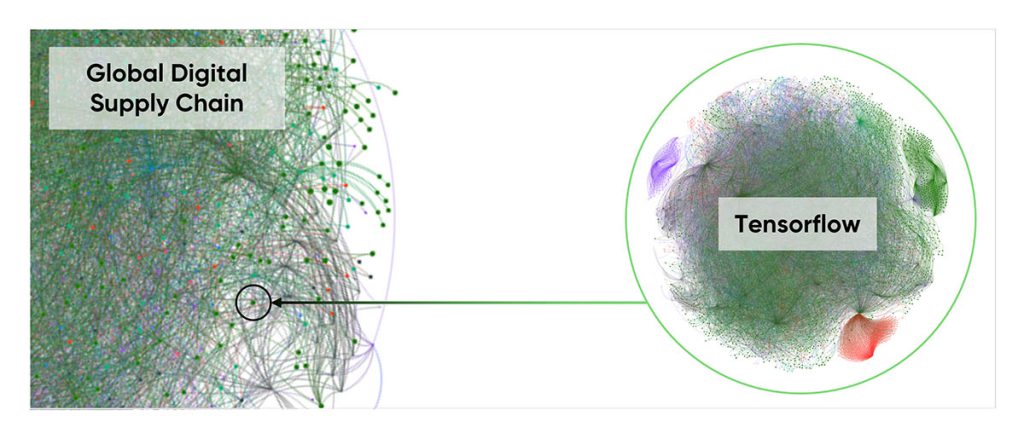
Digital sovereignty starts with the reality of the global digital supply mesh. Look beneath a single application and you find a vast network of software components, libraries, SDKs, APIs, cloud infrastructure, SaaS tools, hardware, semiconductor supply chains, energy, and raw materials, with each node potentially restarting another mesh of nodes.
Abstraction & Sediment
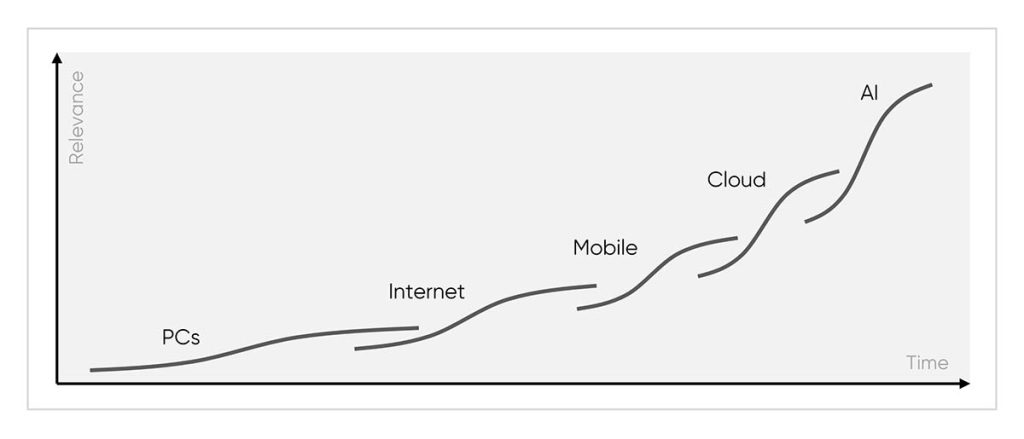
Decades of technology accumulate within organizations: mainframes, client server systems, mobile, cloud, and now AI. Interfaces and abstraction make this complexity manageable, enabling organizations to build global, profitable and innovative businesses based on technologies they neither created nor fully understand. The downside is that organizations accumulate dependencies and risks they do not fully control.
Jekyll & Hide
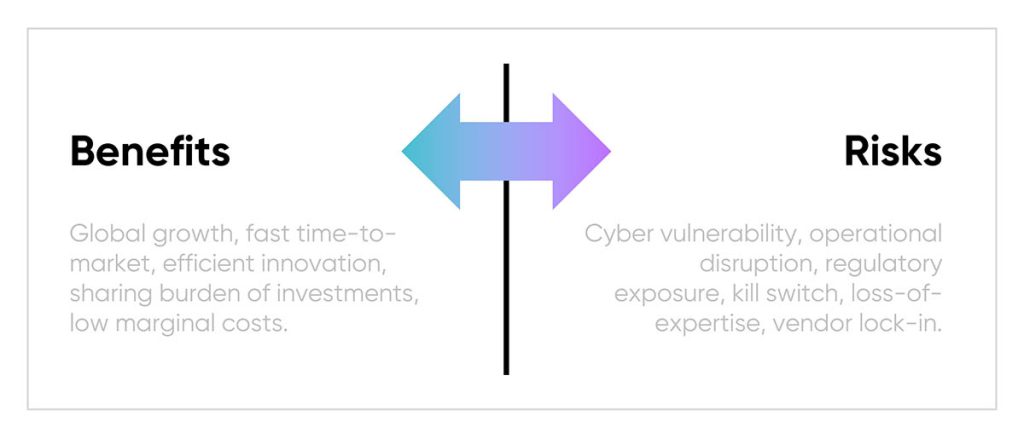
The beauty of this setup is that specialization, global investment, and convenient reuse give everyone access to extraordinary technological capabilities at low marginal cost. The beast is that relying on those capabilities creates exposure to cyber vulnerability, operational disruption, loss of expertise, regulatory exposure, kill switches, and vendor lock in. The uncomfortable truth is that these sovereignty risks are not a flaw in the global technology stack. They are the other side of what makes it so powerful.
The Three Sovereignty Dilemmata
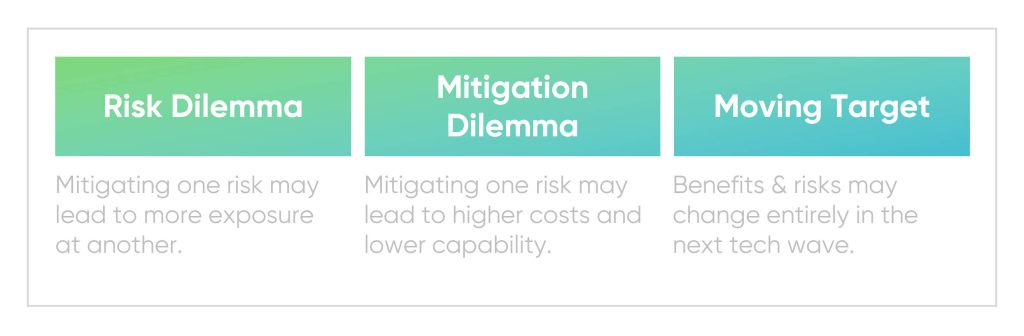
Mitigating these risks is possible through open source, local providers, encryption, redundancy, abstraction layers, open standards, data portability, multi cloud, hybrid cloud, or insourcing. But mitigation comes with trade offs. Running your own cloud may reduce kill switch exposure and vendor lock in while increasing cyber vulnerability and operational disruption (Risk Dilemma). Mitigating those risks through additional expertise and redundancy requires more resources and may still mean giving up capabilities available from specialized providers (Mitigation Dilemma). And none of these trade offs are permanent: the next technological wave can change what is secure, what is expensive, and what even constitutes vendor lock in (Moving Target).
The Sovereignty Calculus
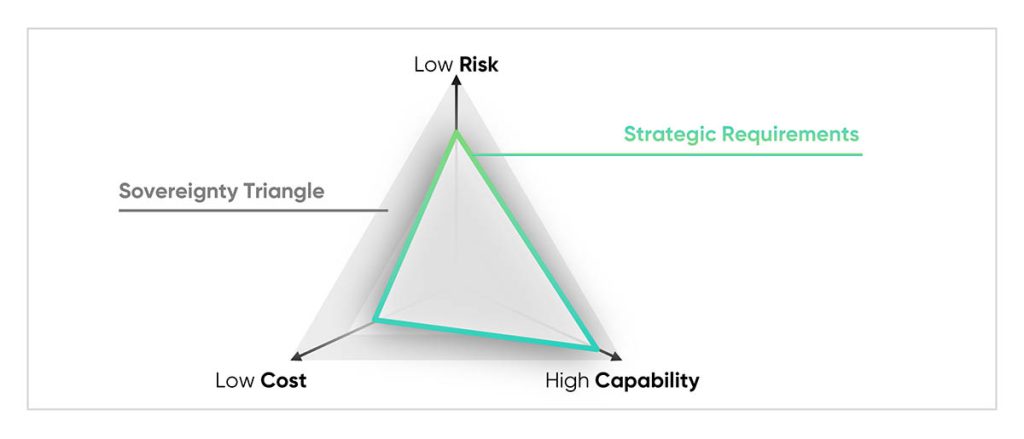
Cloud ahead therefore proposes a new thought model for optimizing digital sovereignty under economic constraints. Sovereignty is not a binary state to achieve once, but a continuous optimization across risk, cost, and capability. Strategic requirements determine where an actor wants to be, while technical maturity determines how easily it can move there. The Sovereignty Calculus helps consumers, companies, public institutions, and entire nations understand their option space, evaluate trade offs, prioritize the risks that actually matter to them, and make tangible progress toward greater sovereignty in practice.
The Micro-Macro Trap
Consumers, SMEs, and enterprises face a different Calculus than nations and societies. Microeconomic actors usually optimize for their individual view on cost, risk, and capability, benefiting from the low investment, high capability, high security, and high availability of global technology providers. But millions of individually rational decisions accumulate into macroeconomic dependence. Asking those actors to solve it by migrating away simply shifts the cost back to them through expensive migrations, opportunity costs, and reduced technological capability.
RiskOps as a Micro-economic solution
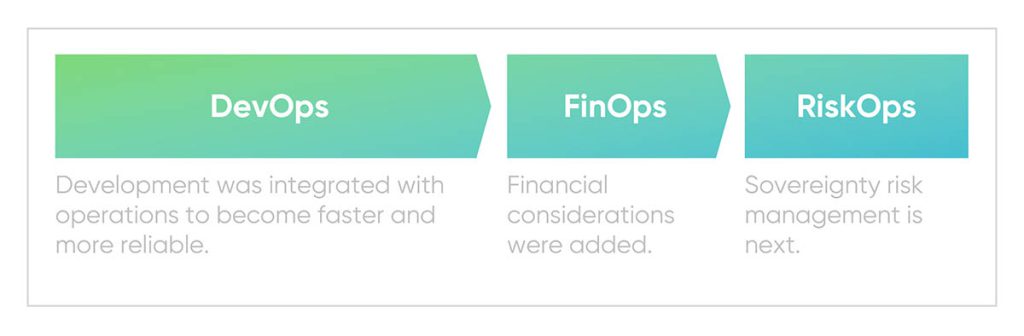
The microeconomic solution following from the Sovereignty Calculus is to make sovereignty risk mitigation cheaper. Instead of trying to mitigate all six risks for everyone, RiskOps helps actors identify the risks that actually matter to them and apply the most cost effective mitigation to only them. Following the example of FinOps, it would establish sovereignty risk as a standard technology practice, with shared frameworks, tooling, benchmarks, and mitigation patterns integrated directly into engineering and procurement.
Chokepoints as a Macro-economic Solution
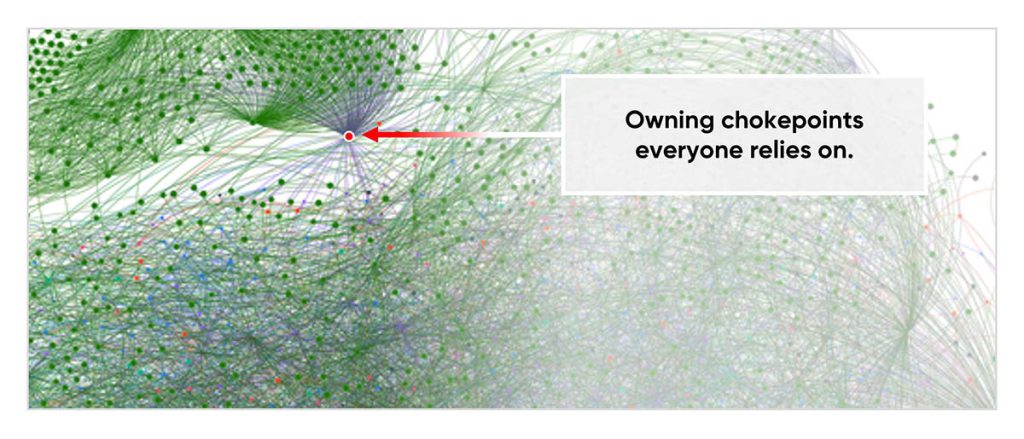
The same characteristics that make the global technology stack risky are also what make it economically attractive. Therefore, replicating existing technologies through massive investment is an economically unattractive path to sovereignty. Instead, cloud ahead proposes creating counter-dependence through global chokepoints. More positions such as ASML or SAP, where others depend on European technology without readily available alternatives, would give Europe reciprocal leverage by making Europe indispensable to others.
Platform Shifts as opportunities for chokepoints
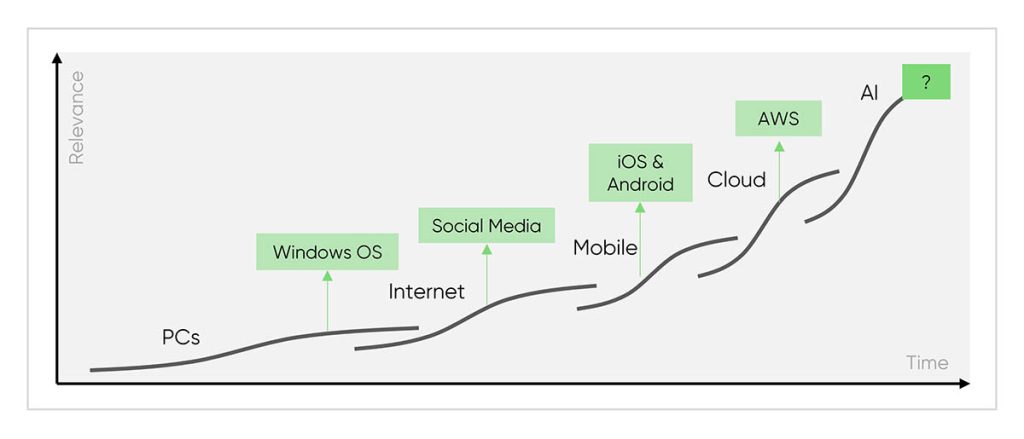
Building new chokepoints means focusing on upcoming technology platform shifts rather than already consolidated markets, as history shows that such shifts repeatedly redistribute technological power. Apple and Google captured mobile operating systems and weakened Microsoft’s desktop dominance, while similar early bets helped create the positions of ASML and SAP. Europe should therefore use its existing industrial strengths to capture critical positions in AI, robotics, quantum, and fusion, backed by sufficient risk bearing growth capital, supportive competition law, and industrial policy designed to enable global scale.
A Viable Strategy For European Digital Sovereignty
Europe’s sovereignty challenge is ultimately an economic allocation problem. Capital, expertise, and technological capacity are scarce. Spending them to replicate mature technologies that can already be sourced globally reduces some risks, but comes at extraordinary cost of investment and capability losses.
A better strategy is to spend sovereignty resources where they have the greatest effect. RiskOps does this at the microeconomic level by targeting specific risks with proportionate mitigation. At the macroeconomic level, Europe should concentrate investment on emerging technologies where its existing strengths can develop into global chokepoints and create counter dependence.
The result is a different understanding of digital sovereignty: not reducing European dependence on the global tech stack, but maximizing European freedom-of-action with the resources available. Use the global technology stack where its economics are compelling, mitigate the risks that matter, and invest aggressively where European leadership can create lasting strategic leverage.