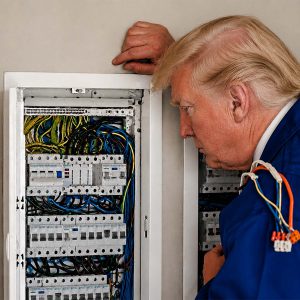

Trump is giving Europe a lesson in international technology politics. Less in a cognitively direct fashion, more the way American scholars do it: with practical use cases. Or, as the US legal system would call it: in case law.
The two model cases for European sovereignty
The problem case
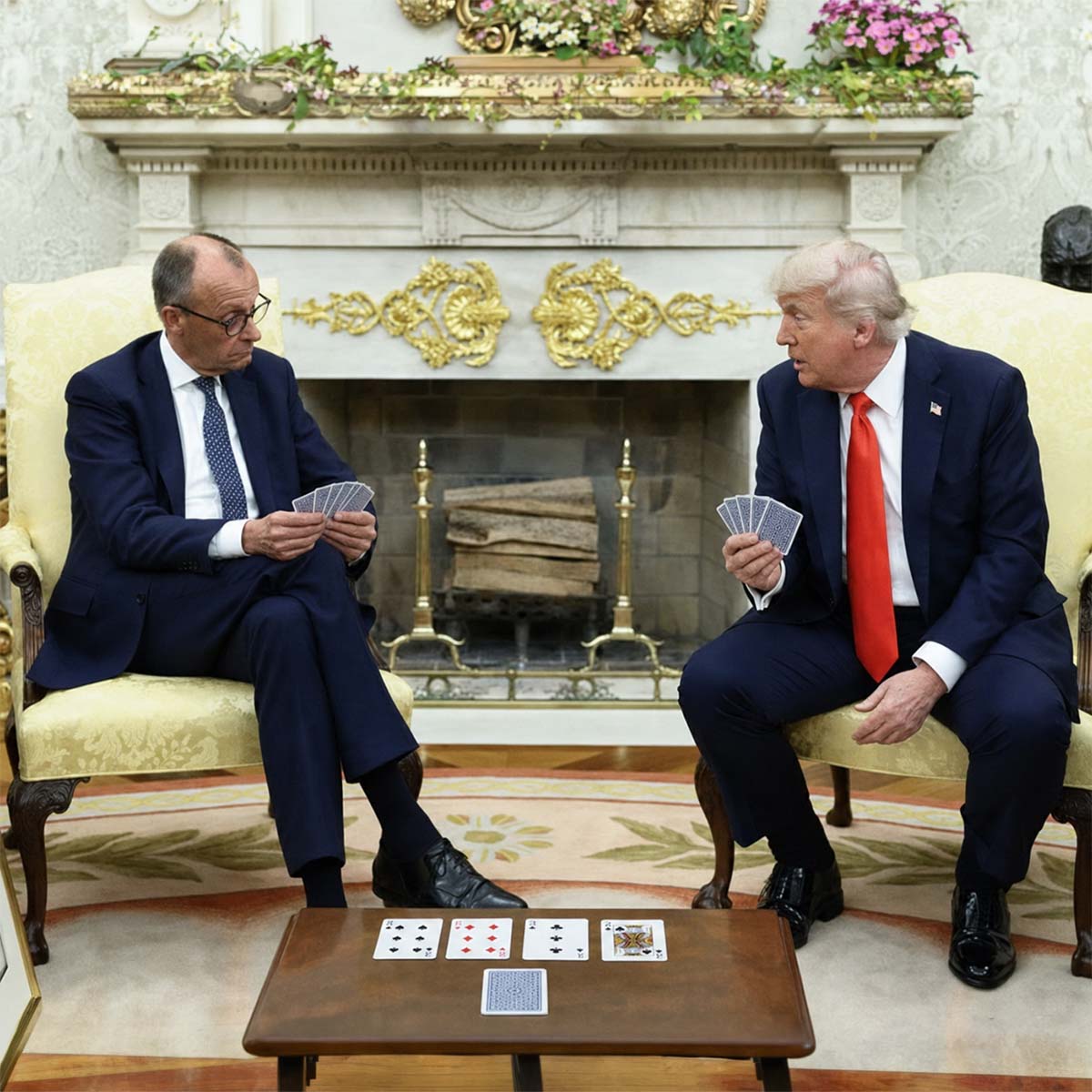
When Trump and Zelensky had their infamous meeting in the Oval Office, Zelensky came asking for help, hat in hand. He wanted Trump's support, weapons and more. But Trump wanted something else. The Nobel peace prize. So he asked Zelensky to surrender to Putin, a peace that could be credited to Trump. Then Trump told him directly: "You don't have the cards right now. With us, you start having cards." And obviously Trump had the weapons Ukraine needed: long range weapons to strike Putin's hinterland, and interceptor missiles so Ukraine wouldn't get struck itself.
The solution case
Then came the Iran war, which Trump started a year later. Trump thought he had the cards. He sent overwhelming force to the Gulf and started bombing. But then came the Persians and Helmuth von Moltke's insight that "No plan survives first contact with the enemy.“ Iran closed the Strait of Hormuz. A simple move, done with comparably simple weapons. Shahed drones, nicknamed "flying lawnmowers" for their piston engine sound, cost between 20,000 and 50,000 dollars each. Oil tankers couldn't leave the strait anymore, Brent crude gained about 65 percent by the end of March 2026. And all the US friendly states around the Gulf suddenly had to fear getting bombed themselves. These big beautiful tax havens, safe homes against global Wohlstandsneider (poor people envying rich people’s wealth), turned into a crisis zone where wealth became difficult to protect.
Three Lessons of Trump
How do these stories connect? Ukraine, backed by Europe's industrial base and financing, started developing its own long range weapons. And, being under pressure with a war on its doorstep, this turned out to be a good combination. With Heraclitus's "war is the father of all things" in mind, pressure and necessity jointly reinvented the wheel. Faster than any traditional military purchasing process would allow, and cheaper than any financial controller of the army could have imagined, swarms of smart engineers built the weapons themselves: long range Flamingo missiles at roughly a quarter to a third of the cost of a comparable Tomahawk. Interceptor drons, interference resistant and whatever else was needed. And a military coordination application that outperforms what siloed American warfighters can do with their legacy systems.
And the irony: who did the Gulf vassal states turn to once they got bombed, after their American protector left them to fend for themselves? To the EU backed dominant player of modern warfare. Only Ukraine could offer next gen weapons that actually protect against Shaheds.
Looking at the two cases, there are a few points where we need to be exact.
Sovereignty is about chokepoints, not independence
Ukraine wasn't independent when it had the disastrous meeting with Trump on February 28, 2025. It still isn't. It depends on European money and financing, on global chip supply, and heavily on China: about 89 percent of Ukrainian drone makers rely on Chinese parts. Western microelectronics tell the same story from the other side, chips from STMicroelectronics, Analog Devices, and Texas Instruments keep turning up in the Russian drones aimed at Ukraine, since both sides draw from the same global supply chain.
Iran is not independent either. It depends on Chinese engines, navigation chips, and satellite guidance, including access to China's BeiDou system. And it depends on global oil revenue, most of it now flowing through China, which buys Iranian crude at a discount and supplies weapons technology in return, a barter loop between oil and hardware well documented by now.
The position of power in both cases comes from dominating one specific thing that's needed right now. Missiles in Ukraine's case, cheap oil transit in Iran's case.
Owning chokepoints is about economics, not evil intent
The US owned the chokepoint of western weapons not because it's so complicated to design a cruise missile. Ukraine built the Flamingo from idea to first successful battlefield test in under nine months. The western world outside the US just didn't bother to invest so much money in building the respective capacity. It just didn't make sense economically. We called it the peace dividend, I guess, and spent it on early retirement for Social Democrat voters and company car subsidies for Christian Democrat friends.
Chokepoints often aren't about advanced technology at all. Hormuz matters because shipping oil is cheap. Bypass pipelines already exist, Petroline and Habshan-Fujairah, built during earlier tanker wars. But they move only 3.5 to 5.5 million barrels a day, against 15 to 20 million through the strait. Expanding takes one to two years, even now. Nobody bothered sooner because it worked fine for decades. Time and money countries wanted to spend otherwise.
Next-gen tech is the solution, not replication
Now, when you finally decide to build stuff on your own, you do it in a different context, or, as the latin proverb goes: Tempora mutantur et nos mutamur in illis. When the Americans designed their cruise missile, it was the 80s. They have a whole industrial complex built around that old tech, with a huge innovator's dilemma. Old purchasing processes, old incumbents, slow, state-driven innovation. Now comes Iran, orders lawnmower engines on Alibaba, builds some metal wings around them, connects it to GPS and can knock out desalination plants around the Gulf for roughly the price of a used car.
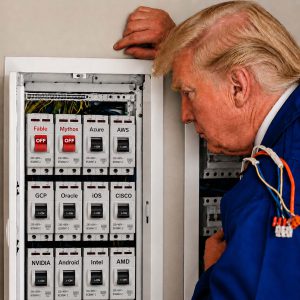
Ukraine replied in the same fashion. An interceptor drone runs around $1,500 to $2,500 and uses standard materials. It developed sharp software to stay safe against jammers. And everything runs through an API feeding into central databases. No mainframe, all cloud. It's Microsoft, AWS and Google. The companies many sovereignty advocates want Europe to abandon first are protecting European sovereignty where it actually matters most.What an irony.
Big Tech`s Playbook for Global Dominance
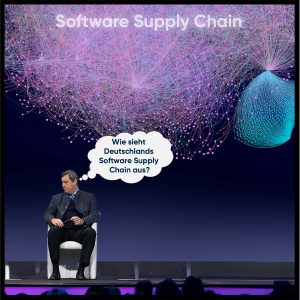
Europe is too dependent on US technologies, no discussion. Two thirds of European cloud services run on US hyperscalers, and 67 percent of German companies say they cannot operate without them. More than 80 percent of Europe's digital technologies and infrastructure are imported, and 70 percent of foundational AI models used worldwide come from the US. European companies account for just 7 percent of global research spending on software and the internet. Suppose von der Leyen sat in a meeting with Trump, she wouldn't know what trump cards to play. What a pun.
But, with the three Trump lessons in mind (owning chokepoints, caring about economics, utilizing next gen tech) we just need to learn from those who own today's chokepoints: US Big Tech. Their strategies have been wonderfully described, yet disguised as critique, in Bertelsmann's EuroStack initiative, Annex A, "Strategies of Dominance."
- Vertical integration. Fusing hardware, software, platform, and infrastructure layers so a user or business cannot easily use one layer without the rest.
- Ecosystem lock in. Designing products to interlock so switching means abandoning the whole stack, not just one product.
- Data accumulation and reuse. Capturing data from one business line and feeding it into others, improving targeting, R&D, or new products.
- Infrastructure control as leverage. Owning the underlying layer, cloud, cables, chips, operating systems, payment rails, that others depend on, then setting the terms of access.
- Rent extraction. Using a gatekeeper position to charge fees or impose conditions on third parties who rely on the platform.
- Market boundary blurring. Expanding across previously separate domains, consumer and enterprise, hardware and services, so competition can no longer be contained to one category.
- Standard setting. Becoming the de facto reference that others must build around, converting scale into rule making power.
- Self reinforcing cycles. Structuring the business so growth in one segment strengthens another, compounding advantage rather than each segment competing independently.
Combine that with the insight of how dominance shifts follow platform shifts, and EuroStack's own point that Europe needs far more venture capital to carry the risk of this kind of build, and you get a clear playbook:
- Unfair Advantage. Start from what you already do better than anyone else.
- Next Generation Technologies. Point that advantage at what's coming, not what's already built.
- Emerging Businesses. Turn the new technology into a business nobody has scaled yet.
- Scaling Growth. Fund it with venture capital, the only capital built for this kind of risk.
- Strategies of Dominance. Apply proven big tech practices, and bring in ethics and regulation once the externalities show up.
This is what has worked in the past, and until we figure out how to build global chokepoints with regulation, ethical considerations, and governmental purchasing processes, apply what works.
There are two types of chokepoints
We're doing this exercise to figure out how to build European owned counter chokepoints. Or: How to build trump cards against Trump. Before we apply theory, we need to be exact about what actually makes a chokepoint.
A chokepoint is a position in a value chain that others cannot bypass without significant disruption, delay, or loss of capability. Whoever controls it gains leverage over everyone who depends on it.
There are two types:
- Instant Leverage. The capability is replaceable in principle, but not quickly enough. The leverage comes from the gap between how fast access can be withdrawn and how long substitution takes. Examples: social media platforms, and the Strait of Hormuz.
- Unmatched Depth. The capability rests on accumulated knowledge, engineering ability, or institutional expertise that cannot realistically be replicated, even with substantial capital and political will. Examples: ASML, and TSMC.
Instant leverage dependencies are solvable with redundancy and transition planning. The real problem is political will to accept short term financial disadvantages. At the Strait of Hormuz, Saudi Arabia could have built more pipeline capacity sooner. Germany could have accepted world market gas prices instead of cheap Russian gas.
Unmatched depth dependencies demand something harder: getting in early, before the knowledge gap opens and becomes closable only with long-time resource commitments to catch-up.
Building Chokepoints in Practice
The point is this needs to apply throughout the depth of Europe's industrial stack, not just the surface layer everyone argues about. Here's one concrete example.
Europe's real asset is decades of expert knowledge locked inside specialized companies, like laser physics at Trumpf, optics at Zeiss, sensors at Bosch. That knowledge is hard won and hard to copy. But it's always been deployed the old way, sell better machines to the same customers, protect margins, avoid risk. Same innovator's dilemma as before.
Turning that knowledge into a chokepoint means pointing it at a different kind of business, a cloud, a platform, a data layer, not just a better machine. That pivot needs venture capital, not bank loans or industrial private equity, because it can fail outright before it works. Europe has the expertise. What's been missing is capital built to carry that risk, and the willingness to combine the two.
Lets take the German machinery business as an example.
Instant leverage: dominate industrial clouds
The playbook would work like this:
- Unfair Advantage. European machinery makers build some of the world's best industrial equipment, e.g. lasers, precision optics, decades of engineering knowledge nobody else has.
- Next Generation Technologies. e.g. AI, quantum sensing, next gen battery chemistry, point that expertise at whichever frontier fits the domain.
- Emerging Businesses. These machines sit in a value chain, suppliers on one side, customers on the other. Don't just sell better machines. Turn the data flowing through that chain into a cloud platform other players want to plug into.
- Scaling Growth. Banks won't fund an unproven platform business, and machinery engineers won't want to build one. Spin it into a startup the company partly owns, and let it fail fast or scale fast.
- Strategies of Dominance. Once it works, cannibalize the machine sales it grew out of. The old business becomes the EBIT engine funding the shift from machine maker to platform owner.
The key to instant leverage chokepoints is combining software, hardware, cloud, and data with high market share. Software, and especially cloud, gives you a kill switch. Data gives you lock in. High market share gives you relevance. Technically, copying you would be easy. Economically, nobody will, same as the Strait of Hormuz, because it just is not worth the resources.
Unmatched Depth: Exploiting Technological Finesse
This one works differently because the economics are different. Instant leverage is about switching cost and network effects, the tech could be copied, but copying takes time nobody wants to spend. Unmatched depth is about knowledge that can't be copied at any speed, because it took decades to accumulate. That flips the playbook: instead of racing to lock customers in, you're racing to understand where an unsettled technology is headed and occupy the entire field first.
- Unfair Advantage. Look again at your strengths. This may also be machinery, specialty software and algorithms, specialty gases required for quantum, highly purified materials, and more.
- Next Generation Technologies. Wherever there is technology, there will be a next generation of it. Right now at the horizon: specialty components for quantum computing or photonics, next gen semiconductor materials, fusion energy components, advanced robotics, or synthetic biology tools, and more.
- Emerging Businesses. The market barely exists. A few other companies are experimenting too. You need to understand the dynamics shaping what comes next. This is what ASML did with EUV lithography, and why it's Europe's lead chokepoint today.
- Scaling Growth. Bet again, because it's not always clear where the industry lands. This may include buying up relevant competitors while they're still cheap, before any consensus forms on where the technology goes.
- Strategies of Dominance. Once the direction is clear, protect your lead. Stay the cheapest provider long enough that nobody has an incentive to invest against you. If a competitor emerges, cut prices until they can't survive it. Keep investing until your market share is overwhelming.
The disadvantage of this chokepoint is that it isn't immediately effective. If NVIDIA stopped supplying chips tomorrow, the chips already out there would keep working for a while. But the advantage is: you cannot easily catch-up by building a pipeline or scaling your cloud infrastructure.
Rethink Our Industrial Base Through Schumpeter's Eyes
Joseph Schumpeter's idea of creative destruction, old business models torn down to build the new, is exactly the logic this playbook runs on.
The same logic that only imagined for machinery is already sitting inside industries that don't yet see themselves as tech companies. European cars carry cameras and sensors that could become the nervous system of entire cities, mapping traffic and free parking in real time, tying manned and unmanned vehicles together for semi autonomous delivery, or supplying the road tested eyes the coming robotics industry hasn't built yet. Insurers hold something rarer still, decades of accumulated knowledge about how the physical world actually fails, and the leap worth making isn't to start running the businesses they insure, it's to become the layer those businesses can't operate without, the way a search engine never had to sell a single product to become indispensable to everyone selling one. Defense is already proving the model works, Ukraine's Gulf deals show what happens when integrated, decentralized battlefield intelligence outruns an incumbent still fighting the last war, the same opening Iran found with drones bought off Alibaba. Telecom equipment makers like Ericsson and Nokia sit on an overlooked one, every 6G base station they roll out is also a transmitter, and a dense enough network becomes a passive radar grid for free, detecting aircraft, stealth included, by reading the shadow they cast across signals already filling the air. Imagine this trump card: We provide stealth identifying radar on telco equipment as a free service to every country in the world with the only requirement to let it run on European clouds.
There's a lot here. Not just because Europe isn't as bad as it feels, but because technological change is gaining pace and width. We stare at our dependency on US hyperscalers and think "that's it." We ignore that nobody, not even the US or China, will manage to build every single layer of the tech stack themselves.
You Don't Have to Like Trump to Learn From The US
Trump didn't mean to teach Europe anything. But case law works that way, the lesson sits in the precedent, whether or not the judge intended one.
Here's what the precedent says. Sovereignty isn't independence, it's chokepoints. Nobody is self sufficient, not Ukraine, not Iran, not the US, not China. What matters is which single thing you control that everyone else needs right now. Owning that chokepoint isn't a moral failing on someone else's part, it's usually just the result of nobody bothering to invest, because for decades it made no economic sense to. And when you finally do build your own capability, you don't rebuild what the incumbent already has. You skip the old industrial complex entirely and go straight for the next generation, the way Iran did with drones bought off Alibaba, the way Ukraine did with a missile built in nine months and a battlefield system that runs on American clouds.
That's the whole trick. Two kinds of chokepoints follow from it. Instant leverage chokepoints, like hyperscalers or a shipping strait, work through switching cost, technically easy to copy, economically nobody does. Unmatched depth chokepoints, like ASML, work through decades of expertise nobody can buy their way past. Different economics, different playbooks, same underlying move: unfair advantage, next generation technology, an emerging business built around it, venture capital willing to carry the risk, and then the proven strategies of dominance once it works.
None of this requires Europe to leave the global tech stack, and none of it requires pretending Europe starts from zero. It has the industrial depth, the engineering knowledge, the specialized companies nobody else has. What it's missing is the capital structure willing to point that knowledge somewhere new, and the willingness to let Schumpeter do his work, tear down the comfortable business model before someone else does it for you.
Trump asked Zelensky who has the cards. Europe should start making cards. We can.