

Last week, the Bertelsmann Stiftung published a widely recognized paper on how a European footprint in the global tech stack could look like. The document can be downloaded here. It is 128 pages long—and because its language is dominated by nominalizations, abstract value terms, and future-oriented modal rhetoric that signal urgency while obscuring concrete agency, I took the effort to read it for you, so that you don’t have to.
Who are the ideators?
The Eurostack is led by Francesca Bria, together with Paul Timmers and Fausto Gernone. It is backed by a network of established institutions, most notably the Bertelsmann Stiftung, Stiftung Mercator, the Centre for European Policy Studies, and the UCL Institute for Innovation and Public Purpose—a mix of influential foundations, think tanks, and academic actors closely connected to European policy-making.
What is the core idea?
The Eurostack Bria envisions a unified, sovereign digital infrastructure as the foundation of Europe’s strategic autonomy. It frames the Eurostack as a political “moonshot”—comparable to the Euro or Single Market—aimed at moving Europe from dependency to self-determination. More than a technical stack, it is a federated, value-driven framework designed to align digital infrastructure with democracy, privacy, and sustainability.
What is their style?
The Bria-Eurostack is styled as a mission-driven “moonshot” that combines ambition with execution. Its defining feature is the consistent bridging of opposites: it presents itself as bold yet pragmatic (long-term vision paired with MVPs), Europe-first yet non-protectionist (strategic autonomy without isolation), unified yet decentralized (a common stack built in a federated way), and competitive yet compassionate (industrial strength aligned with social equity and the common good). Even its governance reflects this tension—positioned as an engine of disruption while still relying on structured, accountable institutions.
What are the most representative quotes?
A defining rhetorical pattern of the Bria-Eurostack is the repeated use of “not just / more than” framing to expand its scope. The initiative is described as “more than a technological program”, “not just about technology”, and “more than infrastructure”—instead positioning itself as a political, economic, and societal project at once:
"Together, we can build a future in which digitalization serves not as a source of division but as a force for the common good. ... we invite you to consider how this mapping and its recommendations can help spark innovations that are both competitive and compassionate."
What is the theory of change?
The Bria-Eurostack follows a mission-driven, state-enabled approach: Europe builds a unified digital stack (from chips to AI) and scales it through public investment and “Europe-first” procurement. This creates demand, consolidates fragmented markets, and enables startups to scale within the Single Market. As capabilities grow, Europe regains control over the value chain while embedding public values such as privacy and sustainability.
What measures do they propose?
The Bria-Eurostack translates its vision into the following measures:
- Financial & market interventions: A €300 billion Sovereign Tech Fund combined with “Europe-first” procurement targets to create demand and scale European providers
- Common digital stack: Building core services across cloud, AI, chips, data, identity, and connectivity as a unified European infrastructure
- Agile execution: MVP-driven “EuroStack Challenges” to rapidly deploy and scale real-world use cases in sectors like health, mobility, and manufacturing
- Governance & principles: New oversight structures, open-source-first policies, and sustainability requirements (“green by design”)
What is the institutional base?
The institutional base of the Bria-Eurostack is diffuse: it draws on a network of foundations, think tanks, and academic institutions, but is not anchored in a single entity. It resembles an informal inner circle, held together by a shared narrative rather than a transformative organization.
What are they actually doing?
Given its diffuse, network-based structure, there is little evidence that the Bria-Eurostack operates as a distinct implementation vehicle. The participating institutions largely continue their existing work in research, policy advice, and advocacy—now framed under the Eurostack narrative if applicable.
What does success look like?
Success for the Bria-Eurostack is framed as a somewhat vague “moonshot”: moving Europe from technological dependency to strategic autonomy. It entails building competitive European tech industries, shifting from value extraction to value creation, and developing an integrated, interoperable digital infrastructure aligned with public values. Ultimately, success is a Europe that not only regulates but actively builds and governs its digital ecosystem.
How likely is success?
As neither the initiative nor the goals are well-defined, its chances of success appear low and high at the same time. As the Bria-EuroStack’s core strength lies in its ability to translate factual tensions into persuasive narratives, it casts the project as a “strategic necessity” rather than investing time into execution questions. Looking at it as a political initiative, it has already succeeded by attracting significant attention.
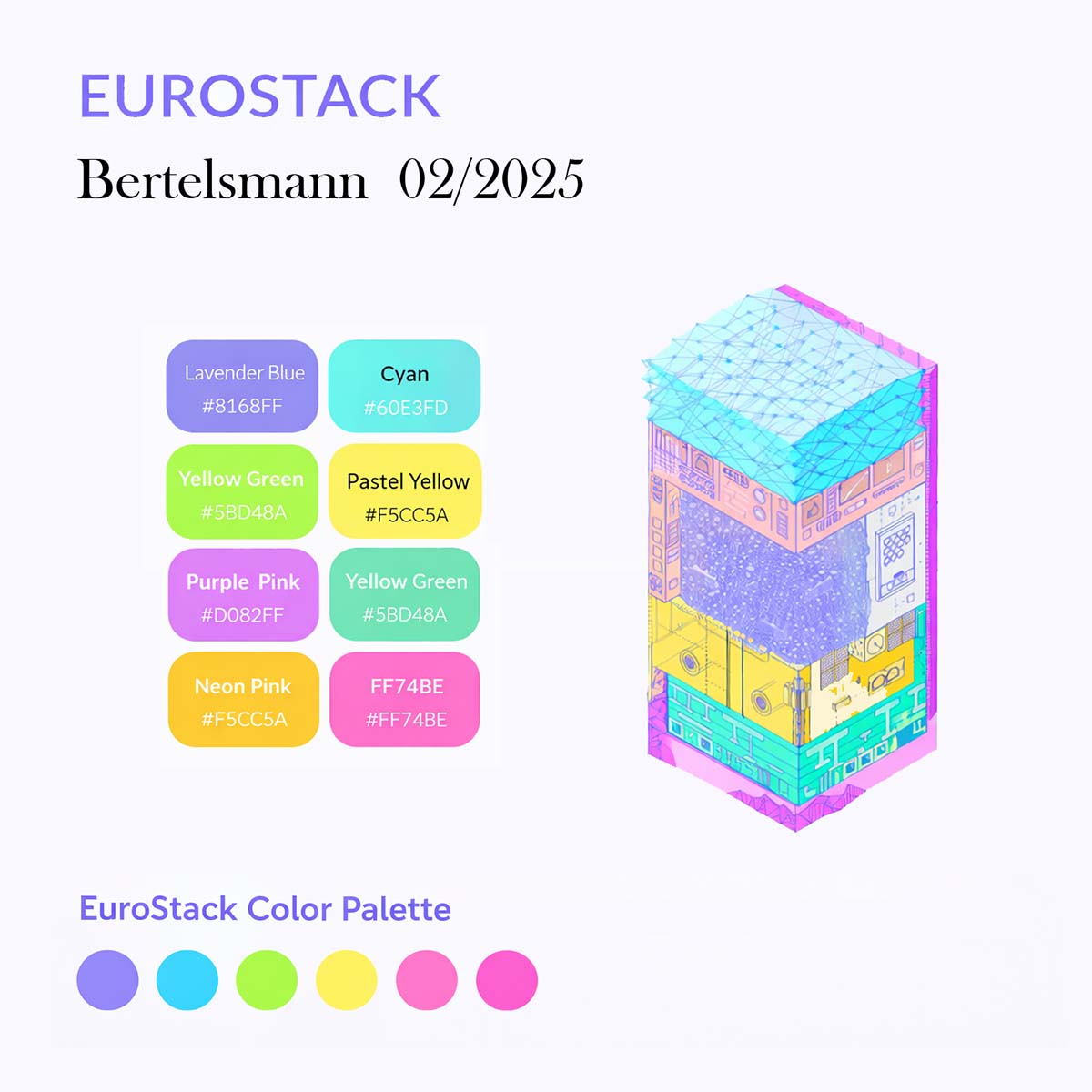
For you to help navigate on the internet: All the visuals connected to the Bertelsmann/Bria vision follow the color scheme in the title picture.